
eCommerce moves quickly. Every week there’s a new tool, tactic or optimisation promising to lift conversion rates. They can all be useful in the right context, but none of them reach their potential unless the brand behind them actually means something to people.
That’s the core of brand commerce.
It’s where a clear identity and a coherent story meet the systems that help customers buy, and it’s the space we at Farrows have worked in for decades.
What we mean by brand commerce
Buying doesn’t begin at checkout. It begins in the mind – in the expectations, impressions and little signals people pick up long before they’re ready to make a decision.
Brand commerce brings together four things:
- Brand strategy: who we are and why that matters
- Creative expression: the tone, visuals and stories that create feeling
- Behavioural insight: how people actually browse, compare and decide
- Commerce mechanics: the tech and touchpoints that make buying simple
When these elements line up, the commercial experience feels natural and not forced.
Why this matters now
People rarely follow tidy customer journeys anymore. They move from discovery to purchase in the space of a few swipes. Inspiration on social, reassurance from reviews, a quick look at a product page. At that crucial point, they’re either lost or converted.
In that environment:
- Trust carries more weight than ever
- Emotion cuts through where features can’t
- Consistency builds confidence
- Friction loses sales instantly
A brand that feels familiar and dependable has an advantage long before anyone clicks “add to cart.”
Where Farrows sit in all this
We’re a brand agency first. And because we’ve been around since 1979, we’ve seen how buying behaviour has changed again and again, from catalogue orders to early eCommerce to the omnichannel landscape we work in today. That long view shapes our approach.
It means:
1. We build commerce on strong brand foundations
We always start with meaning: story, identity, value. When those are clear, everything that follows becomes easier and far more effective.
2. We know how to turn that meaning into a smooth buying experience
As a Shopify Plus Partner, we know how to use the platform in ways that protect and elevate a brand rather than compromise it. And because we’ve supported international brands through major shifts in their online strategy, we know what actually makes a difference and what simply adds noise.
A working example: Tricker’s “Classic Men’s Looks”
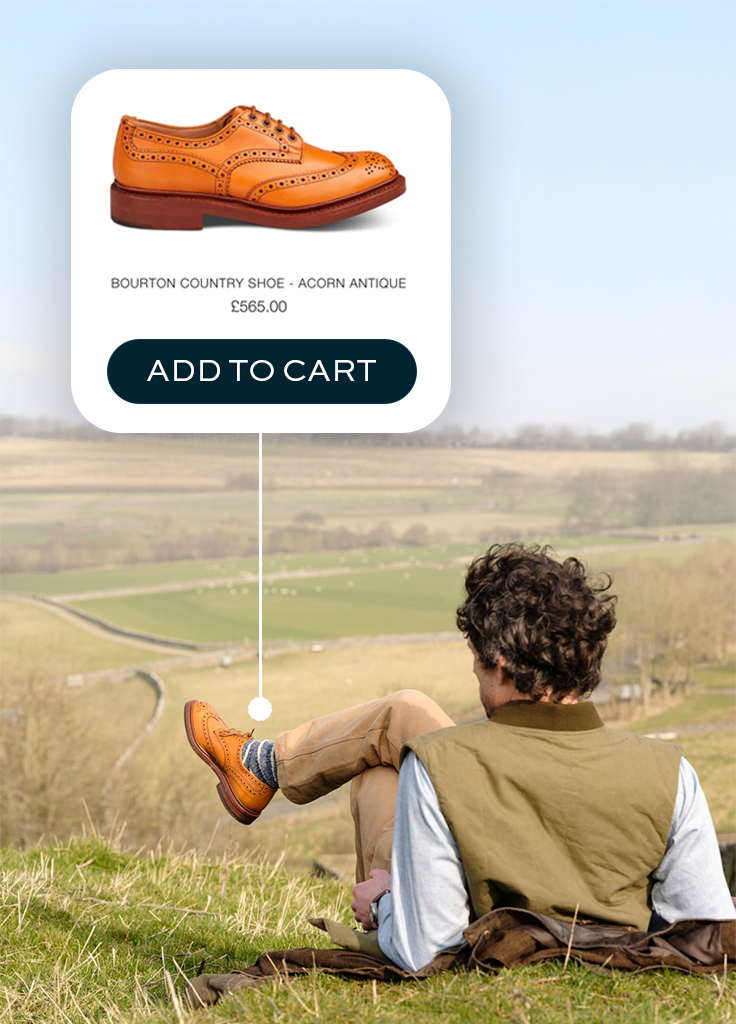
A good illustration of brand commerce in action is our work with Tricker’s. The “Classic Men’s Looks” project was a content series designed to help Tricker’s customers see how their footwear fits into real life. We developed a set of complete outfits built around key Tricker’s styles, each one worn by an individual whose personality and approach to style felt authentic to the brand.
It wasn’t about selling shoes in isolation. That was just a byproduct. The goal was to show the footwear in everyday contexts that resonate with Tricker’s customers – well-made pieces worn by people with genuine character and practical style. The concept reflects what Tricker’s has always stood for: quality, longevity and a no-nonsense kind of confidence.
We handled the full creative direction and production: concept, styling, talent, photography and film. We chose individuals whose style naturally reflected the values of the brand, and used their stories to add depth and authenticity.
We then paired the footwear with a complementary clothing brand to broaden the context and extend the reach. Once the visual world was established, we rolled the creative out across the website, email, social and paid media, creating one continuous story from inspiration through to purchase.
It drove awareness, engagement and importantly, more sales.
That’s the essence of brand commerce: a clear idea, expressed consistently, supported by good technology, and aligned with how real people shop.
What brands can do right now
A few principles tend to make the biggest difference:
Start with clarity: If a brand can’t articulate its role or value, no platform or plugin can fix that.
Create an emotional throughline: Everything, from photography to copy to UX, should reinforce the same feeling and message.
Design for real behaviour: People need trust signals, comparison, reassurance and consistency. Make those easy to find.
Use technology with intention: Shopify Plus, Yotpo and other partners are part of the brand experience, not afterthoughts.
Keep the journey connected: When paid media, email, social and site all reinforce each other, the path to purchase feels effortless.
The future of eCommerce is brand-led
Tools will keep evolving and the landscape will only get more competitive. The brands that stand out will be the ones that know who they are and communicate it clearly, across every touchpoint.
Brand commerce puts meaning at the centre of the commercial experience. And for businesses ready to rethink how they sell, that combination is where the real opportunity sits.